A GPU spends most of its power moving data to compute. We delete the movement: antenna signals enter as voltages, conductances do the multiplication, currents sum themselves — 65,536 operations in one physical event, no clock, no data movement. That's how a beamforming supercomputer fits on a satellite's power budget.
Digital accelerators spend almost all their energy shuttling weights back and forth between memory and arithmetic units. In orbit — where you have watts, not kilowatts — that overhead is fatal. Analog in-memory computing deletes the movement entirely: the weight never leaves the cell, because the cell does the math.
The weights of a neural network are stored as the electrical conductance of nanoscale ReRAM cells. From there, the arithmetic is just what the devices already do.
Drive a cell of conductance G with a voltage V and the current I = G·V is already the product — one multiplication, one device, no logic.
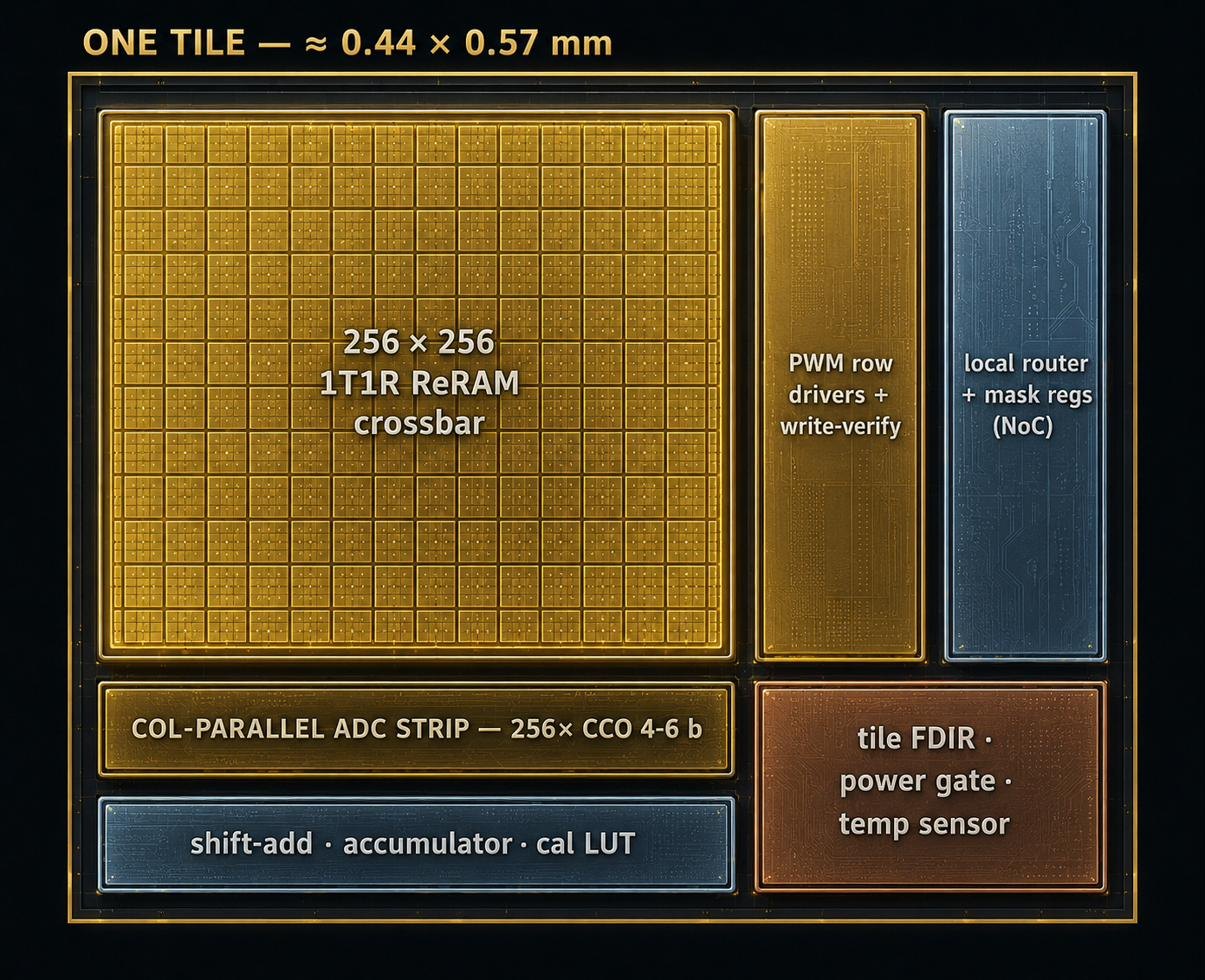
Tie 256 cells to one wire and the currents add themselves. A 256×256 tile is 65,536 multiply-accumulates in a single physical event.
A weight is the shape of a conductive filament a few nanometers wide — not stored charge. A particle strike has nothing to flip.
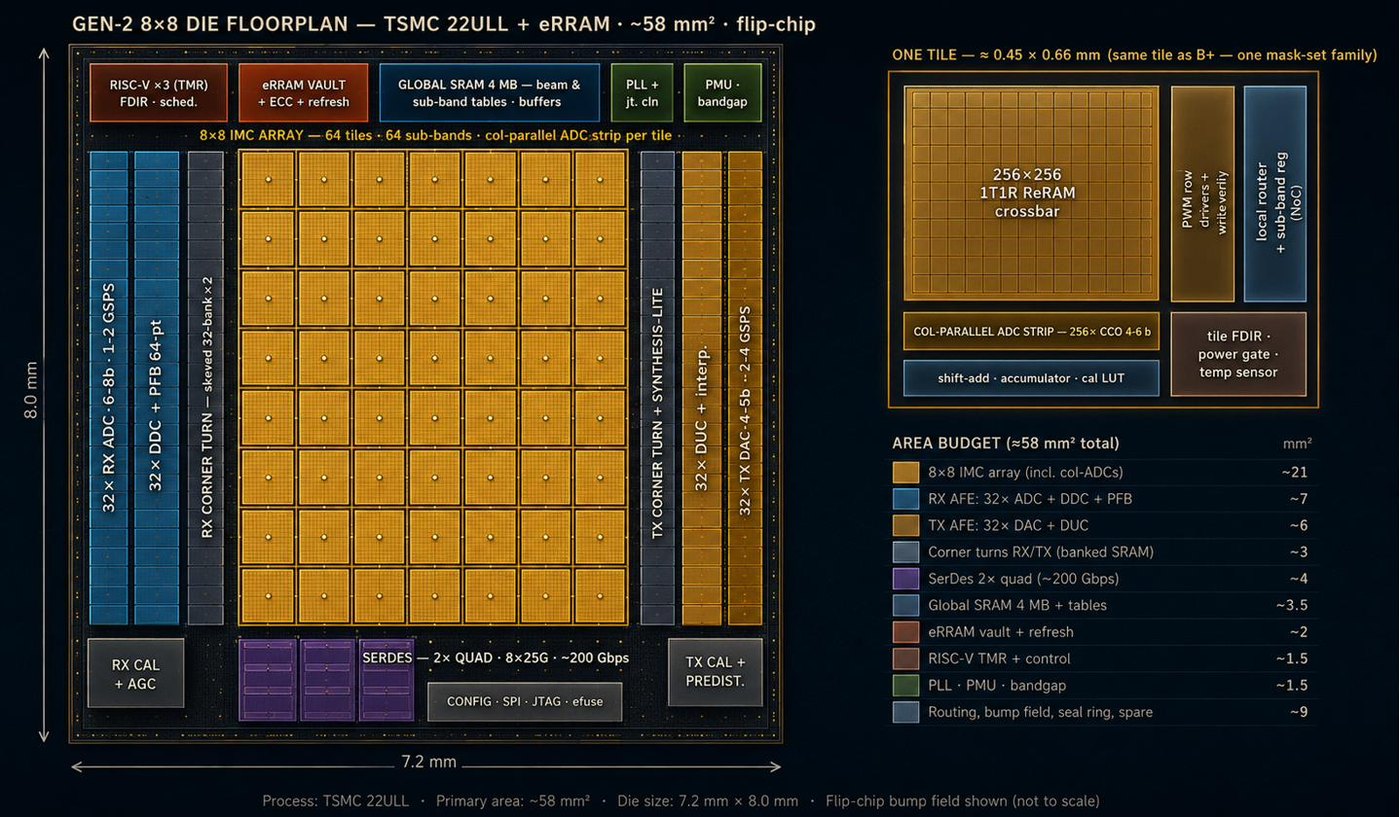
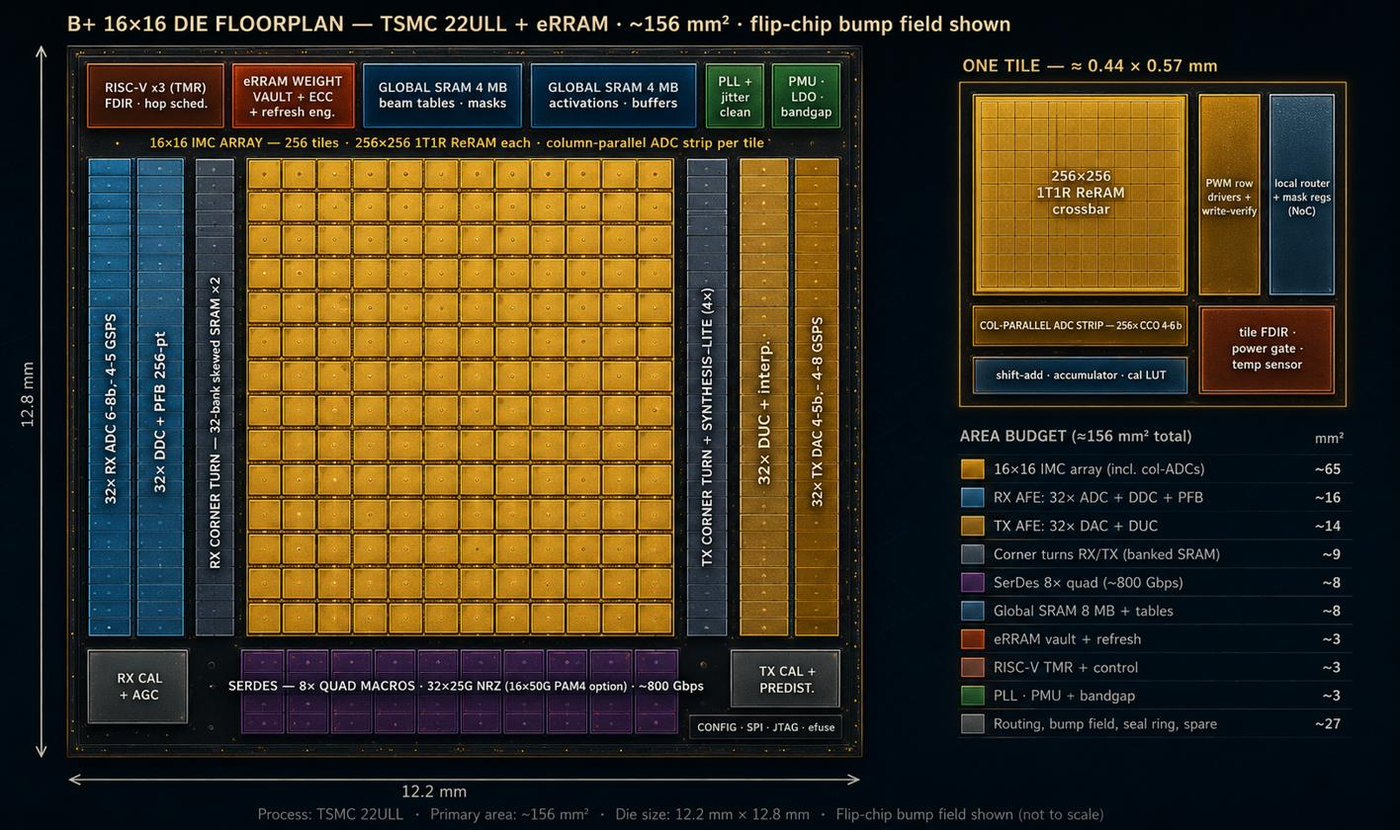
The same analog tile — a 256×256 ReRAM crossbar — qualified on a single mask-set family, so each generation inherits the last one's evidence and scales the array.

A single 256×256 tile — crossbar, PWM drivers, column ADC strip and calibration — that proves the cell in real silicon.

A 32-chain beamforming engine: 64 squint-free beams in ~3 W on a ~58 mm² die, built for an in-orbit demonstration.

The full payload chip: 64 beams across a 2 GHz window at ~13 TOPS, 15–25 TOPS/W on a 156 mm² die. GEO and IRIS²-class.
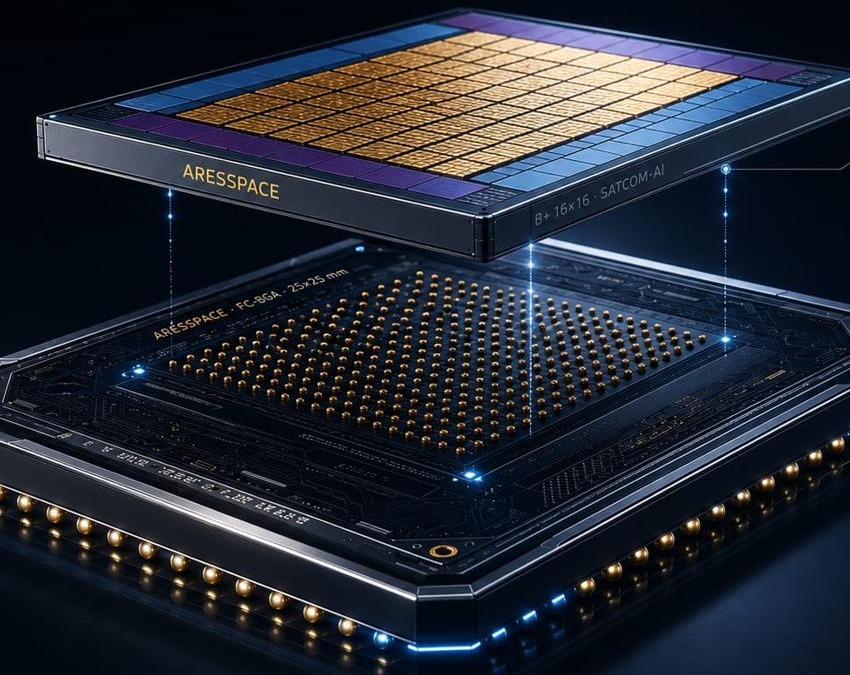
The B+ 16×16 — 256-tile die above its flip-chip FC-BGA package · render, illustrative geometry
256 analog tiles, each 65,536 multiply-accumulates per read — that's the raw ceiling. We deliver ~13 TOPS to the beamforming workload at just 10–12 W, and the gap isn't lost compute: it's compute we never spend.
Beamforming weight matrices are sparse. The chip evaluates the products that form the beams and nulls — not all 65,536 cells in every tile, every cycle. Less arithmetic by design, not by limitation.
Tiles not in use are power-gated. A GPU draws near-full power even at 20% utilization; here, unused compute costs zero watts — which is exactly why the efficiency reaches 15–25 TOPS/W.
The raw ceiling assumes a 30 MHz readout. The sub-band math only needs ~10 MHz, so we run the converters where the signal lives — racing them faster would spend power for no useful output.
A conventional payload needs racks of phase shifters and DSPs to form and steer its beams. On the B+, that whole subsystem collapses into one 156 mm² die — because beamforming isn't a processing stage bolted on, it is the chip. Here's how it works.
A phased array isn't limited to a single beam. By applying several weight sets to the same antenna data in parallel, the chip forms independent beams pointing at different users simultaneously — each one a separate matrix-vector multiply, all computed in the same analog read. This is how a single payload serves dozens of spot beams across its coverage. Digital beamforming, delivered by true analog-AI power.
Because a beam is a matrix-vector multiply and a null is the same multiply with different weights, steering 64 beams and nulling every interferer happens in one analog read — squint-free across the full 2 GHz window, with nulls that stay deep where phase-only systems collapse. Adaptive MVDR nulling stops being the expensive part of the payload.
The same crossbar that makes the chip efficient makes it jam-resilient. Performance and protection come from the same physics.
Traffic in orbit is bursty — a cell that's busy now is idle a moment later. Instead of lighting every cell continuously, a hopping beam dwells where the demand is and jumps to the next cell in microseconds, following the traffic. The dwell schedule is just another weight pattern, so the beam re-points with no settling time and no moving parts — capacity goes where it's needed, instant by instant.
A digital hopping payload burns power and latency every time it recomputes the beam weights. On the B+, the new dwell pattern is one more analog read of the crossbar — microsecond hops, no DSP in the loop. The same physics that forms the beams, nulls the jammers, and hops the traffic. One die, one operation, every job.
From the package in your hand to the filament you'll never see — every claim is anchored in a drawing, designed end to end on TSMC 22ULL + eRRAM.
Flip-chip FC-BGA, RF escapes clear of the SerDes edge.
16×16 analog tile array, one mask-set family across all three chips.
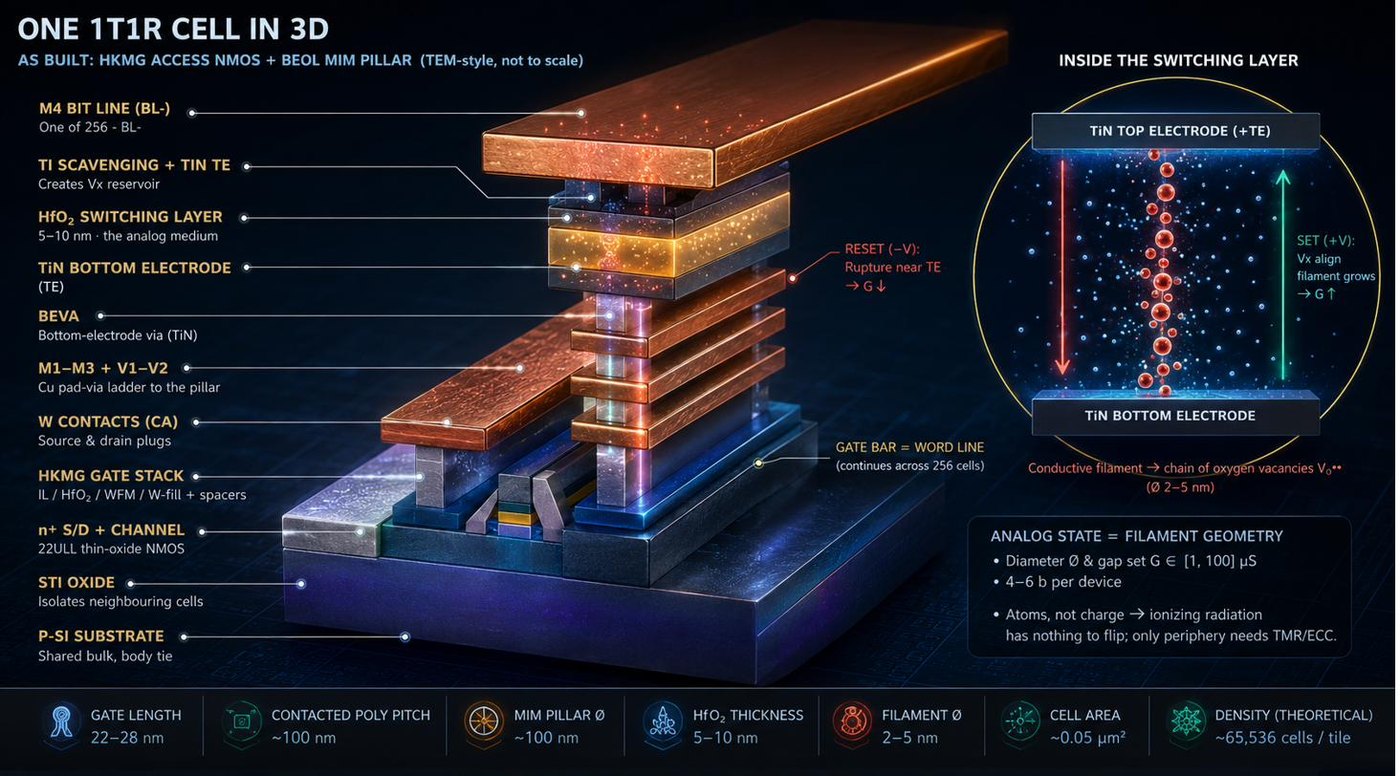
One transistor + one ReRAM device, weight stacked in the metal.
TiN / HfO₂ / Ti stack between metal layers — zero FEOL area.
A chain of oxygen vacancies. The analog weight. Immune by physics.
We're talking to investors, payload primes, and engineers who want to build it. If sovereign, jam-resilient space compute is in your remit, we should talk.